Ubuntu snap-confine Flaw Lets Local Users Gain Root on Default Desktop Installs
A high-severity flaw in Ubuntu's snap-confine utility could let any local user escalate to root on default desktop installs of Ubuntu 24.04, 25.10, and 26.04.

A high-severity vulnerability in the snap-confine component shipped with Ubuntu could allow any logged-in local user to escalate privileges and take full control of the machine. The issue affects default installations of Ubuntu Desktop 24.04, 25.10, and 26.04, and is tracked as CVE-2026-8933 with a CVSS score of 7.8. Because snap-confine runs setuid root by design, a flaw in its logic has direct security consequences for shared systems, family PCs, developer workstations, and any Linux environment where untrusted local accounts exist.
This matters to website owners and developers who run Ubuntu as their workstation OS, to agencies that standardize on Ubuntu images for staff laptops, and to anyone using Ubuntu as a base layer for containers, build agents, or development sandboxes. A successful exploit hands the attacker root, which means the ability to read secrets, install persistent malware, tamper with SSH keys, modify cron jobs, and pivot into any cloud account or hosting control panel reachable from that machine.
Key Takeaways
- CVE-2026-8933 is a local privilege escalation flaw in snap-confine with a CVSS score of 7.8.
- Default Ubuntu Desktop 24.04, 25.10, and 26.04 installations are vulnerable out of the box.
- Any unprivileged local user can potentially trigger the bug to obtain root access.
- Snap-confine runs setuid root, so a logic flaw in it is directly exploitable for full system takeover.
- Patching the snapd package and limiting local user accounts are the most practical mitigations today.
What the Ubuntu snap-confine Flaw Lets Local Users Actually Do
Snap-confine is the helper that Ubuntu uses to launch sandboxed snap applications, the package format used by the Snap Store and many popular Linux tools. Because it has to set up namespaces and mount points, snap-confine runs with the setuid bit set, meaning it executes as root even when the calling user is unprivileged. That is a deliberate trade-off, and it is exactly what makes any bug inside snap-confine a privilege escalation risk.
The newly disclosed issue, CVE-2026-8933, allows an unprivileged user already logged into the system to abuse the way snap-confine handles certain inputs or paths in order to break out of the intended confinement and gain a root shell. Once the attacker has root, the Ubuntu snap-confine flaw lets local users do anything the legitimate administrator could: read every file on disk, install packages, modify boot configuration, capture credentials, and disable security tools.
Which Ubuntu Installations Are at Risk
The advisory specifically calls out default installations of Ubuntu Desktop 24.04, 25.10, and 26.04. A few points are worth being precise about:
- Server editions without snapd installed by default are generally not affected unless snapd has been added manually.
- Systems that have already received the patched snapd update are no longer vulnerable.
- Custom images that have removed snap-confine or replaced the default snap stack are not in the standard blast radius.
- Any environment where an untrusted user can obtain a local shell is the highest-priority exposure case.
The following table summarizes the exposure at a glance for typical SiteCountry Blog readers.
| Installation Profile | Vulnerable by Default | Attack Vector | Primary Mitigation |
|---|---|---|---|
| Ubuntu Desktop 24.04 default image | Yes | Any local user account | Apply snapd security update |
| Ubuntu Desktop 25.10 default image | Yes | Any local user account | Apply snapd security update |
| Ubuntu Desktop 26.04 default image | Yes | Any local user account | Apply snapd security update |
| Ubuntu Server without snapd | No | Not applicable | Confirm snapd is absent or patched |
| Ubuntu base used inside containers | Depends on image | Local shell inside container | Rebuild images with patched snapd |
Who Should Care About This Advisory
Even though this is a local privilege escalation bug rather than a remote one, the practical risk depends on who can sit at the keyboard or who can land a shell on the machine.
- Web hosting and infrastructure teams running Ubuntu as a workstation OS should treat this as a high-priority patch.
- Agencies and remote teams that issue Ubuntu laptops to contractors or freelancers should patch immediately and audit local accounts.
- Developers using Ubuntu as a base for Docker should rebuild their images after the snapd fix lands. For guidance on setting up Docker on Ubuntu, see our walkthrough on how to install docker on ubuntu 24 04 step by step.
- Anyone running a shared family PC, kiosk, or training lab where multiple people log in should be aware that any one of those users could attempt the exploit.
Practical Steps To Reduce Exposure
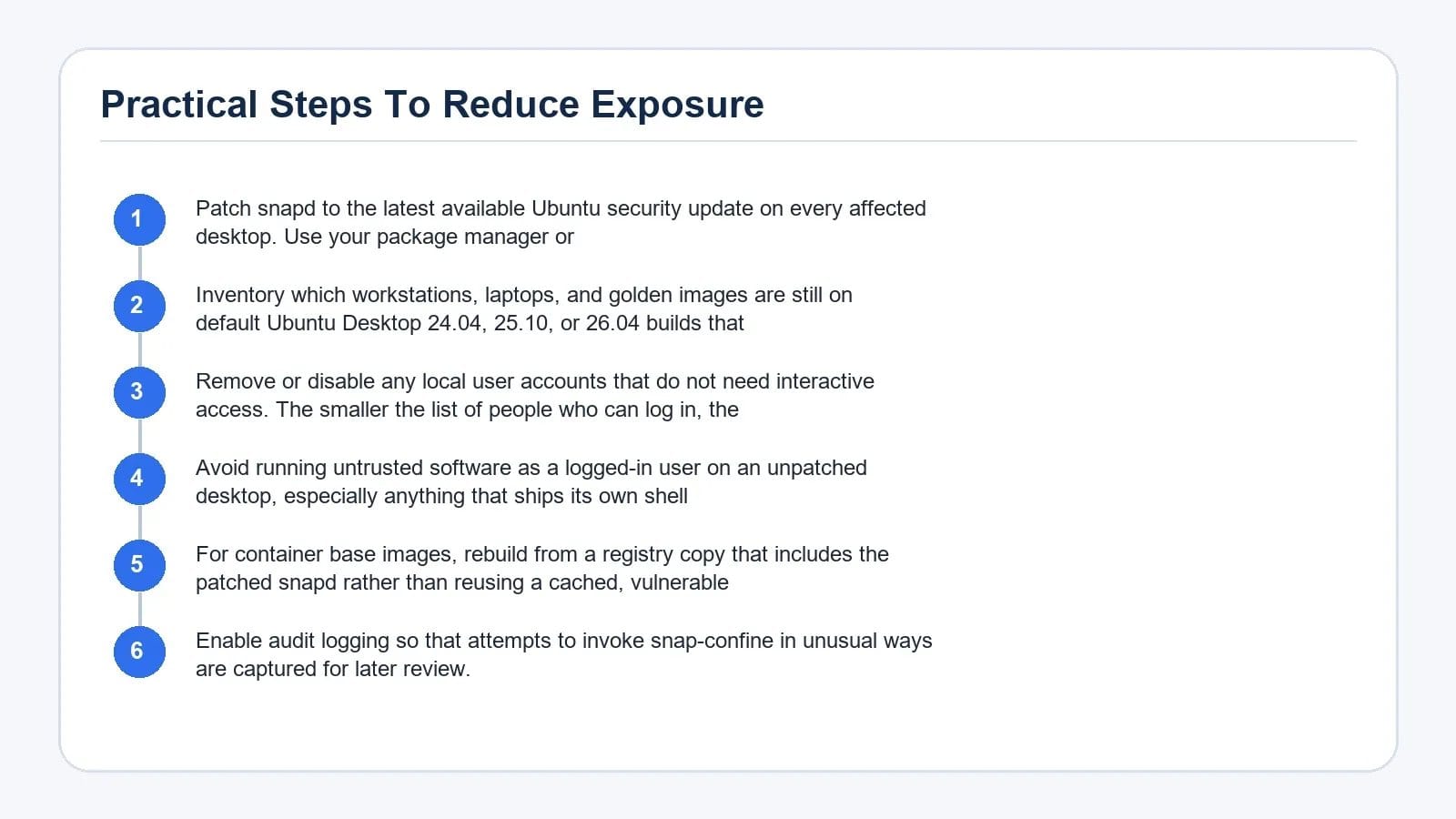
You do not need to wait for a long incident-response process. The mitigations here are standard Linux hardening steps that fit into a normal maintenance window.
- Patch snapd to the latest available Ubuntu security update on every affected desktop. Use your package manager or unattended-upgrades so the fix lands automatically.
- Inventory which workstations, laptops, and golden images are still on default Ubuntu Desktop 24.04, 25.10, or 26.04 builds that have not been updated.
- Remove or disable any local user accounts that do not need interactive access. The smaller the list of people who can log in, the smaller the attack surface.
- Avoid running untrusted software as a logged-in user on an unpatched desktop, especially anything that ships its own shell scripts or binaries downloaded from the open internet.
- For container base images, rebuild from a registry copy that includes the patched snapd rather than reusing a cached, vulnerable layer.
- Enable audit logging so that attempts to invoke snap-confine in unusual ways are captured for later review.
How This Fits the Broader Linux Security Picture
Setuid helpers have long been a focus of Linux kernel and distribution security work, because any flaw in a setuid binary effectively turns into a root compromise. Snap is not unique in this regard, but it is one of the most widely deployed frameworks on Ubuntu, and snap-confine is one of the most privileged helpers in the stack. CVE-2026-8933 is a useful reminder that even on a modern, well-maintained distribution, keeping the base system current is the single most effective control.
For organizations that also rely on control panels, SSL, or web application firewalls, the same principle applies at every layer. For example, knowing how to install SSL certificate on your domain via the control panel is useful only if the underlying server is itself patched. Local privilege escalation issues such as this one sit at the very bottom of the stack, so they should be remediated before, not after, higher-layer concerns.
Frequently Asked Questions
What exactly is CVE-2026-8933?
CVE-2026-8933 is a high-severity local privilege escalation flaw in Ubuntu's snap-confine utility. It carries a CVSS score of 7.8 and can allow an unprivileged local user to obtain root-level access on a vulnerable system.
Which Ubuntu versions are affected by this snap-confine flaw?
Default installations of Ubuntu Desktop 24.04, 25.10, and 26.04 are affected. Ubuntu Server editions without snapd installed are not vulnerable, and systems that have already received the patched snapd package are no longer at risk.
Does this Ubuntu snap-confine issue allow remote attacks?
No. CVE-2026-8933 is a local privilege escalation vulnerability. An attacker needs an existing local user account or shell access on the machine first. The flaw then lets that user escalate from a normal account to root.
What should I do first if I run Ubuntu Desktop on a workstation?
Apply the latest Ubuntu security updates, specifically the snapd update that addresses CVE-2026-8933. Reboot if the package manager requires it, then verify the installed snapd version against the advisory. While patching, restrict who has a local account on the machine.
Are Docker or container workloads on Ubuntu affected?
They can be, if the base image includes the unpatched snap-confine and a container process can reach a local shell. Rebuild base images after the snapd fix is available, and avoid running untrusted containers with root-equivalent capabilities on unpatched hosts.
Conclusion and Action Checklist
The Ubuntu snap-confine flaw that lets local users gain root is a serious reminder that desktop Linux is not immune to privilege escalation bugs, especially when setuid helpers are involved. The good news is that the fix path is simple: keep snapd current, shrink the set of users who can log in locally, and rebuild any golden images that include the vulnerable binary.
- Confirm whether your desktops are running default Ubuntu Desktop 24.04, 25.10, or 26.04.
- Apply the snapd security update from Ubuntu on every affected machine.
- Audit local user accounts and disable any that are not actively needed.
- Rebuild container base images that include snapd so new containers start from a patched layer.
- Enable unattended security updates so future snapd fixes land automatically.
- Re-check the official Ubuntu security notice after patching to confirm the CVSS score, scope, and any follow-up advisories.