Gunra Ransomware Targeting Fortinet and Schneider Electric Edge Devices
A joint South Korean and U.S. advisory warns that Gunra ransomware operators are chaining Fortinet and Schneider Electric vulnerabilities to breach critical infrastructure networks worldwide.
Network defenders at hosting providers, mid-sized enterprises, and critical infrastructure operators are being asked to pay close attention to a fresh advisory about Gunra ransomware Fortinet exploitation. South Korean and U.S. cybersecurity agencies have jointly warned that Gunra operators are chaining flaws in Fortinet security appliances with vulnerabilities in Schneider Electric products to break into networks, move laterally, and deploy file-encrypting payloads. Because both vendors sit at the network edge or inside operational environments, a single unpatched device can hand attackers the keys to the rest of the estate.
Key Takeaways
- Gunra ransomware has been observed exploiting Fortinet and Schneider Electric vulnerabilities to gain initial access and expand inside victim networks.
- Targets include healthcare and public health, financial services, government services and facilities, and professional and nonprofit organizations.
- The campaign fits a broader pattern of ransomware families weaponizing exposed edge appliances and industrial controllers.
- Defenders should treat VPN gateways, firewalls, and OT gateways as priority patch targets and segment them from internal networks.
- Backups, immutable logs, and tested incident response plans remain the most reliable safety nets when edge devices are compromised.
What the Joint Advisory Reveals About Gunra Ransomware
South Korean and U.S. cybersecurity and intelligence agencies published a coordinated warning that Gunra ransomware is being used against critical infrastructure organizations across multiple regions. The advisory describes Gunra as a further variant in an ongoing trend of ransomware families that focus on edge devices and remote access services rather than end-user phishing alone.
By chaining a Fortinet appliance exploit with a Schneider Electric vulnerability, the operators can establish a foothold at the perimeter and then pivot toward operational or business systems behind it. This staged approach helps attackers evade basic email filtering and antivirus controls because the initial compromise happens at infrastructure that defenders often treat as inherently trustworthy.
How the Gunra Campaign Works
The Gunra playbook follows a recognizable pattern seen in modern enterprise ransomware intrusions:
- Initial access through unpatched or misconfigured Fortinet edge appliances exposed to the internet.
- Lateral movement that takes advantage of trust relationships with Schneider Electric devices used for remote management, telemetry, or industrial control.
- Credential harvesting and privilege escalation using legitimate administrative tools to blend with normal traffic.
- Data staging and exfiltration before encryption, increasing pressure on victims who fear both downtime and disclosure.
- File encryption across Windows and Linux hosts, followed by a ransom note directing victims to a negotiation portal.
Because the entry points sit on appliances that often run 24/7, defenders may not notice beaconing traffic or unusual admin sessions until encryption has already started on internal servers.
Affected Products at a Glance
The advisory focuses on two vendor ecosystems that are common in hosting, enterprise, and operational technology environments. The table below summarizes the role each product plays in the observed attack chain.
| Vendor / Product Family | Typical Role | Why Attackers Target It | Defender Priority |
|---|---|---|---|
| Fortinet security appliances | Firewall, VPN, and remote access at the network edge | Direct internet exposure, privileged VPN sessions, frequent use of SSL-VPN | Patch immediately, disable unused VPN features, restrict admin sources |
| Schneider Electric devices | Industrial control, energy management, and OT gateways | Trusted access to operational systems, often lightly monitored | Segment OT networks, enforce MFA on engineering workstations, audit accounts |
Which Industries Are in the Crosshairs
According to the joint advisory, Gunra ransomware operators are concentrating on organizations where downtime translates directly into financial or public-safety risk. Reported target sectors include healthcare and public health, financial services, government services and facilities, and professional and nonprofit services. These verticals share several traits that make them attractive:
- They rely on always-on remote access for staff, partners, and contractors.
- They hold regulated data where a breach disclosure adds legal pressure to pay.
- They often operate mixed IT and OT estates that complicate rapid patching.
- They depend on third-party vendors who may themselves run Fortinet or Schneider Electric gear.
Hosting providers and managed service providers should also be alert, because a compromise of their infrastructure can cascade into dozens of downstream customer sites.
Hardening Steps Hosting Customers Can Take Today
Defending against the Gunra ransomware Fortinet exploitation chain does not require exotic tooling. Most of the value comes from disciplined baseline hygiene applied to edge and OT devices.
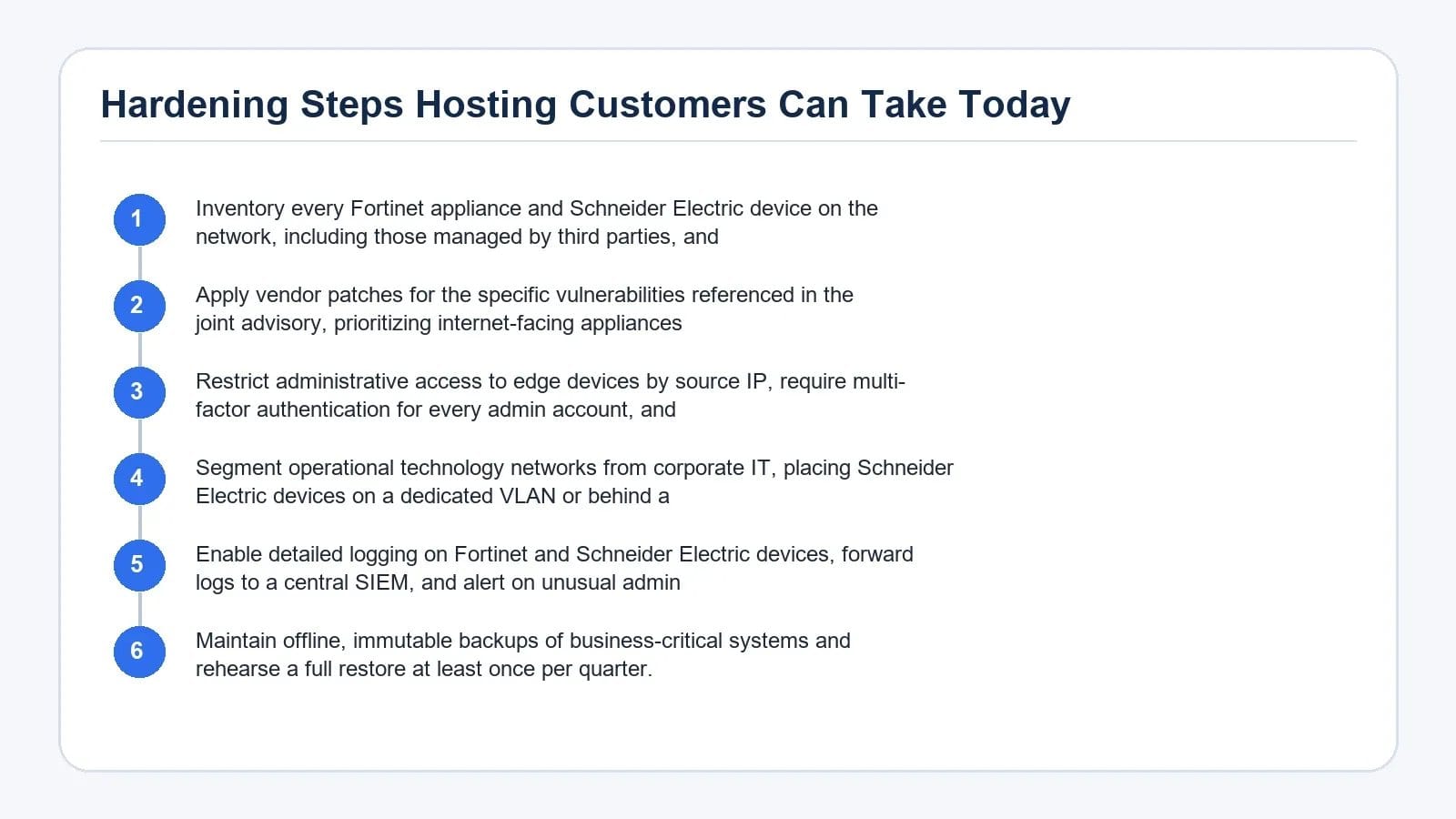
- Inventory every Fortinet appliance and Schneider Electric device on the network, including those managed by third parties, and confirm each one is on a vendor-supported firmware version.
- Apply vendor patches for the specific vulnerabilities referenced in the joint advisory, prioritizing internet-facing appliances first.
- Restrict administrative access to edge devices by source IP, require multi-factor authentication for every admin account, and disable unused VPN portals.
- Segment operational technology networks from corporate IT, placing Schneider Electric devices on a dedicated VLAN or behind a jump host.
- Enable detailed logging on Fortinet and Schneider Electric devices, forward logs to a central SIEM, and alert on unusual admin logins or configuration changes.
- Maintain offline, immutable backups of business-critical systems and rehearse a full restore at least once per quarter.
- Practice an incident response runbook that assumes the perimeter has already been breached so the team can isolate hosts quickly when encryption begins.
If you outsource any of this work, review your provider's patch cadence and ask for written confirmation that Fortinet and Schneider Electric devices are covered by their managed security services. Companies that offer Malware Removal and Security support can often assist with the cleanup if a host is already infected.
Why Edge Appliances Keep Being Targeted
Gunra is the latest in a long line of ransomware families that treat perimeter and OT devices as soft targets. Edge appliances are attractive because they sit directly on the internet, often run for years without reboots, and frequently hold VPN or admin credentials that unlock the rest of the network. Once attackers are inside the appliance itself, host-based defenses on Windows or Linux servers may never see the intrusion until payloads are dropped from a trusted source.
This is also why Professional Business Email hardening, while still important, is no longer enough on its own. Threat actors increasingly skip email entirely and go straight for exposed VPN concentrators, remote management ports, and engineering workstations.
Frequently Asked Questions
What is Gunra ransomware?
Gunra is a ransomware variant documented by South Korean and U.S. cybersecurity agencies as being used against critical infrastructure targets worldwide. It is associated with attacks that exploit Fortinet and Schneider Electric vulnerabilities to gain access before encrypting systems and demanding a ransom.
Which Fortinet and Schneider Electric products are being abused?
The joint advisory points to flaws in Fortinet security appliances used for firewalling and VPN services, combined with vulnerabilities in Schneider Electric devices commonly used for industrial control and energy management. Specific product names and CVE identifiers should be confirmed against the latest vendor security bulletins.
Who is most at risk from this campaign?
Organizations in healthcare and public health, financial services, government services and facilities, and professional and nonprofit services are highlighted as primary targets. Any business that exposes Fortinet VPN portals or runs Schneider Electric OT gear on the same network as corporate IT should treat itself as at risk.
How can hosting customers detect a Gunra intrusion early?
Watch for unexpected administrative logins on Fortinet appliances, configuration changes outside change windows, new VPN accounts that were never requested, and outbound traffic from Schneider Electric devices to unfamiliar destinations. Centralized logging and a SIEM that correlates edge and OT events dramatically improves early detection.
Should victims pay the ransom if they are hit?
Law enforcement agencies generally discourage paying ransoms because it funds further attacks and does not guarantee data recovery. Organizations should engage incident response professionals, preserve evidence for investigators, and rely on tested backups to restore operations whenever possible.
Action Checklist
- Identify every Fortinet and Schneider Electric device on your network and confirm firmware support status this week.
- Apply vendor patches for the vulnerabilities mentioned in the advisory, starting with internet-facing appliances.
- Enforce multi-factor authentication on all administrative accounts for these devices.
- Segment OT networks from corporate IT and restrict management interfaces to jump hosts.
- Forward device logs to a central monitoring platform and tune alerts for suspicious admin activity.
- Verify that offline backups exist, are restorable, and are not reachable from the same network as production systems.
- Run a tabletop exercise that simulates a Fortinet or Schneider Electric breach so the team can rehearse containment and recovery.