INC Ransomware Targets SonicWall SMA 1000: What Website Owners Should Know
INC Ransomware has become the dominant actor exploiting newly disclosed flaws in SonicWall SMA 1000 VPN appliances, with victims listed on its leak site since early August 2026.
The INC Ransomware operation has become the dominant threat actor actively exploiting recently disclosed security flaws in SonicWall Secure Mobile Access (SMA) 1000 series VPN appliances. Reporting from Resecurity, published over the weekend of August 1 to 2, 2026, shows the group accelerating activity since the start of the month and listing multiple victims on its data leak site. For website owners, hosting customers, and IT teams running these appliances at the network edge, this development shifts a vendor advisory into an active emergency.
SMA 1000 devices sit between the public internet and internal corporate resources, which is precisely why ransomware crews value them. A foothold on a VPN concentrator can offer direct access to management consoles, file shares, and remote sessions without the noisy tradecraft required to phish individual employees. Understanding how this campaign is unfolding, what SonicWall has disclosed, and what defensive steps are practical today is essential for anyone responsible for an affected environment.
Key Takeaways
- INC Ransomware is currently the most active threat actor exploiting the recently disclosed SonicWall SMA 1000 vulnerabilities.
- Activity has spiked since the beginning of August 2026, with several victims already posted on the group's data leak site.
- SMA 1000 appliances are VPN concentrators, which makes them high-value targets for ransomware operators seeking direct network entry.
- Defenders should treat the situation as an active incident response priority, not a future patching exercise.
- Network segmentation, credential rotation, and verified firmware updates are the most practical short-term controls.
What Happened With SonicWall SMA 1000
SonicWall disclosed security flaws affecting its Secure Mobile Access 1000 series appliances. These are enterprise-class VPN gateways used to provide remote access for employees, partners, and contractors. Once public proof-of-concept code or operational exploit chains begin circulating, ransomware affiliates typically race to weaponize the access before defenders complete their patching cycles.
According to the Resecurity report, INC Ransomware has positioned itself ahead of that curve. The group has been observed exploiting the SMA 1000 vulnerabilities, gaining footholds inside target environments, and moving to extortion by publishing stolen data on its leak site. Several organizations have already been named as victims in the first days of August 2026, which suggests the initial access vector is producing reliable results for the operators rather than occasional one-off success.
Why INC Ransomware Values Edge Appliances
INC Ransomware has built its reputation around double-extortion tactics, where victims are both encrypted and threatened with public data exposure. Edge appliances like SMA 1000 are attractive for several reasons:
- They expose administrative interfaces that may be reachable from the internet, especially if management ports are not fully restricted.
- They often hold cached credentials, session tokens, or VPN configuration data that simplify lateral movement.
- They sit in front of business-critical systems, so downtime from a compromised appliance disrupts operations quickly.
- Defenders sometimes treat appliances as "set and forget," which can delay detection of unusual administrative activity.
For website owners and small hosting operations, this is a reminder that perimeter devices are part of the security perimeter in practice, not just on a network diagram.
Comparing the Risk Profile
The table below summarizes how the current SonicWall SMA 1000 situation compares with typical ransomware risks affecting small and midsize organizations.
| Risk Factor | Typical Ransomware Risk | Current SMA 1000 Campaign |
|---|---|---|
| Primary entry vector | Phishing emails or exposed RDP | Direct exploitation of VPN appliance flaws |
| Detection difficulty | Medium, depends on endpoint tooling | High, appliance traffic often trusted by default |
| Time to exploitation | Weeks to months after disclosure | Days, with active victims already named |
| Blast radius | Often limited to endpoints and file shares | Potentially full internal network via VPN trust |
| Recommended urgency | Patch within standard cycle | Treat as emergency change with rapid verification |
Practical Steps for Affected Organizations
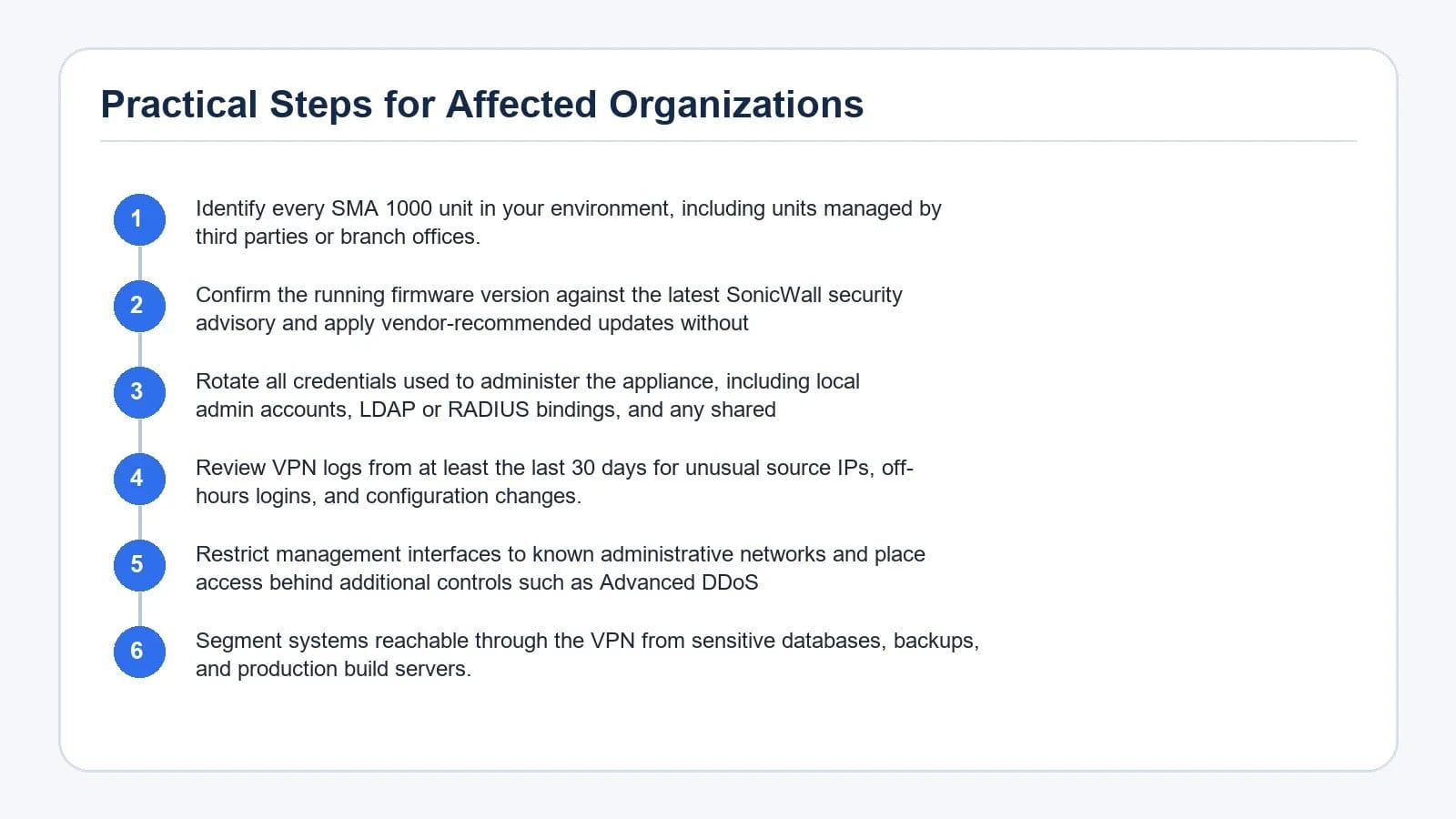
If your environment includes a SonicWall SMA 1000 appliance, treat the next 72 hours as an incident response priority rather than a routine maintenance window.
- Identify every SMA 1000 unit in your environment, including units managed by third parties or branch offices.
- Confirm the running firmware version against the latest SonicWall security advisory and apply vendor-recommended updates without delay.
- Rotate all credentials used to administer the appliance, including local admin accounts, LDAP or RADIUS bindings, and any shared service accounts.
- Review VPN logs from at least the last 30 days for unusual source IPs, off-hours logins, and configuration changes.
- Restrict management interfaces to known administrative networks and place access behind additional controls such as Advanced DDoS Protection where possible.
- Segment systems reachable through the VPN from sensitive databases, backups, and production build servers.
- Validate that offline or immutable backups exist for critical systems before any remediation steps that could trigger destructive activity.
Teams that lack in-house capacity for this kind of triage should consider engaging professional help. If a compromise is already suspected, reaching out to a dedicated Malware Removal and Security service can shorten the path from detection to containment.
Broader Defensive Posture
Even organizations that do not run SMA 1000 hardware can learn from this campaign. Network edge devices, including firewalls, VPN concentrators, mail gateways, and load balancers, are increasingly targeted because they are reachable, privileged, and often under-monitored. A few habits reduce that risk broadly:
- Maintain an inventory of every internet-facing appliance, its firmware version, and its responsible owner.
- Subscribe to vendor security advisories and treat critical disclosures as alerts rather than background reading.
- Enable centralized logging for perimeter devices and feed those logs into your SIEM or alerting pipeline.
- Require multi-factor authentication for any administrative access to network gear.
- Confirm that transport encryption for management is current, including the use of free SSL certificates where appropriate for supporting services.
For high-availability sites, layering edge filtering such as Free DDoS Protection in front of VPN concentrators can also reduce opportunistic scanning, which is often the first step toward a deeper intrusion.
Frequently Asked Questions
What is the SonicWall SMA 1000 vulnerability INC Ransomware is exploiting?
The activity centers on recently disclosed security flaws in SonicWall Secure Mobile Access 1000 series VPN appliances. INC Ransomware has been observed exploiting these flaws to gain initial access to target networks, then moving to data theft and extortion by posting victim names on its leak site.
Who is most at risk from this campaign?
Any organization operating SonicWall SMA 1000 appliances that are reachable from the internet is at elevated risk. The danger is highest where appliances have not yet been updated to the firmware versions recommended in the latest SonicWall advisory, or where administrative interfaces are broadly exposed.
How fast is INC Ransomware moving once it gains access?
Reporting indicates that INC Ransomware has accelerated activity since the beginning of August 2026 and that several victims were listed on its data leak site within days. That pace suggests the group has a reliable exploit chain and is treating the SMA 1000 flaws as a priority access vector.
What should I do first if I run an SMA 1000 device?
Identify every unit in use, verify the firmware against the latest SonicWall advisory, and apply the recommended updates as an emergency change. At the same time, rotate administrative credentials, review VPN logs for anomalies, and restrict management access to known administrative networks.
Is this related to earlier SonicWall issues?
INC Ransomware has a track record of targeting SonicWall products through previously disclosed vulnerabilities. While each campaign focuses on specific flaws, the pattern underscores a broader reality: edge appliances are recurring targets, and timely patching combined with strong administrative hygiene is essential.
Conclusion and Action Checklist
The emergence of INC Ransomware as the dominant actor exploiting SonicWall SMA 1000 flaws turns a vendor advisory into an active incident response situation. Defenders who act within the next few days will significantly reduce the chance of becoming the next entry on a leak site.
- Inventory all SMA 1000 appliances and document their current firmware versions.
- Apply the latest SonicWall security updates on an emergency change schedule.
- Rotate administrative credentials and require multi-factor authentication.
- Review VPN and administrative logs for signs of unauthorized access since late July 2026.
- Segment VPN-reachable systems from sensitive data stores and backups.
- Confirm offline backups exist and are recoverable before any risky remediation steps.
- Tighten network edge controls and consider professional incident response support if compromise is suspected.
Edge appliances are part of your security boundary whether or not you think of them that way. Treating this campaign as a prompt to harden every internet-facing device is the most useful takeaway, and one that pays off long after the current headlines fade.