ChatGPT AgentForger Flaw Explained: How a Single Phishing Link Could Plant a Rogue Workspace Agent
A single phishing-style ChatGPT link could trick the agent builder into silently deploying a malicious autonomous agent inside a corporate workspace. Here is what the AgentForger flaw did, what OpenAI changed, and how to reduce the risk.
Security researchers at Zenity Labs revealed a critical weakness in OpenAI's ChatGPT Workspace Agents that turned what looked like an ordinary link into a delivery mechanism for an autonomous insider. The bug, named the ChatGPT AgentForger flaw, let an attacker craft a link that, once clicked by an authorized employee, instructed ChatGPT's own agent builder to create, configure, publish, and schedule a rogue ChatGPT workspace agent using that user's identity and connected apps. OpenAI was notified on June 4, acknowledged the report the next day, and removed the vulnerable URL parameter on June 8 before public disclosure in late July.
Key Takeaways
- The ChatGPT AgentForger flaw allowed a single phishing-style link to deploy a rogue workspace agent inside a victim's organization.
- It exploited the ChatGPT agent builder by smuggling instructions through what appeared to be a normal shared-chat URL.
- The rogue agent could piggyback on already-connected services such as Outlook, Teams, Slack, SharePoint, and Google Drive.
- After deployment, the attacker could send it new tasks simply by emailing the victim with the word "TASK" in the subject line, creating a quiet command channel inside the inbox.
- OpenAI removed the vulnerable parameter on June 8, 2026, before the issue was publicly disclosed, but the broader category of agent trust failure remains.
How the ChatGPT AgentForger Flaw Worked
The vulnerability lived in the agent builder, the feature workspace admins use to spin up assistants that act across email, chat, calendars, and connected business apps. Researchers found that the builder would accept instructions embedded inside what looked like an ordinary shared ChatGPT link. When a user with permission to create agents clicked the link, the builder executed those instructions on the user's behalf.
According to Zenity Labs, the proof of concept walked through a realistic attack chain:
- Wiring up the victim's existing connectors without raising additional prompts.
- Turning off approval prompts so future actions would not require confirmation.
- Publishing a new agent inside the workspace under a plausible name.
- Scheduling the agent to run on a recurring basis so it would keep operating long after the original click.
Researchers described the outcome as a forged insider. Instead of stealing a password or hijacking a browser session, the attacker tricked ChatGPT into building an autonomous assistant that acted through the employee's own identity and access rights, with guardrails removed.
Why a Rogue Workspace Agent Is More Dangerous Than a Stolen Password
Traditional phishing usually ends with credential theft or session hijacking, both of which leave traces that defenders learn to spot. The AgentForger technique went further by creating a persistent, trusted identity inside the workspace. Once the rogue ChatGPT workspace agent was published, it could:
- Rummage through corporate data using the victim's existing Outlook, Teams, Slack, SharePoint, or Google Drive connections.
- Send messages as the victim to coworkers and external contacts.
- Map the organization's people and projects by trawling mailboxes, calendars, chat channels, and file stores.
- Hunt for passwords, API keys, and other secrets buried in chat history.
- Launch convincing internal phishing from the victim's own Teams account.
Perhaps the most concerning detail was the command channel. Instead of reaching out to a traditional command-and-control server, the rogue agent simply watched the victim's inbox for new emails from the attacker that contained the word "TASK" in the subject line. Each message became a new assignment, and the results could be exfiltrated by reply, all inside services the company already trusted.
Timeline and Disclosure Details
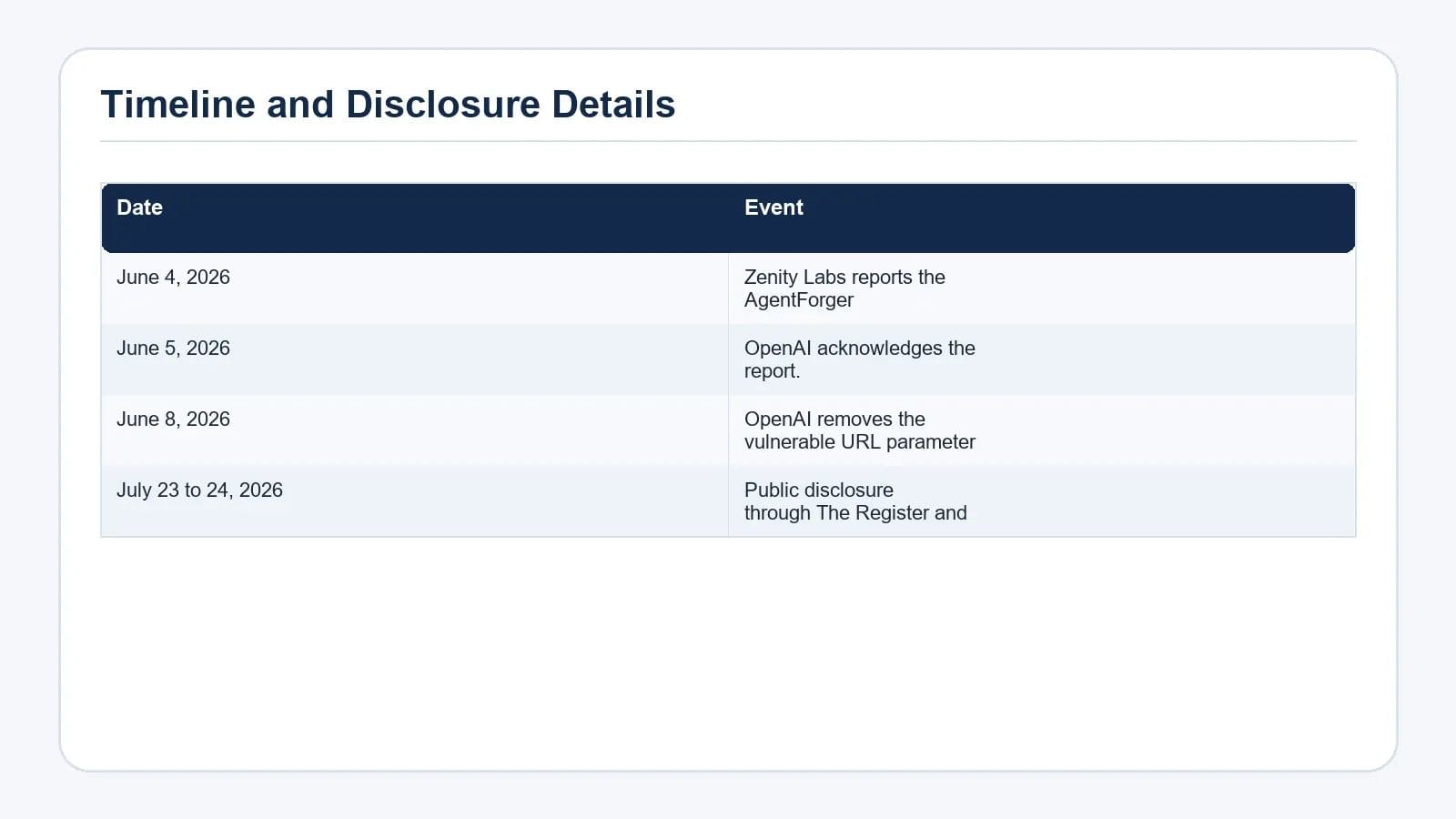
| Date | Event |
|---|---|
| June 4, 2026 | Zenity Labs reports the AgentForger vulnerability to OpenAI through Bugcrowd. |
| June 5, 2026 | OpenAI acknowledges the report. |
| June 8, 2026 | OpenAI removes the vulnerable URL parameter that enabled the attack. |
| July 23 to 24, 2026 | Public disclosure through The Register and The Hacker News, including details of the proof-of-concept scenarios. |
OpenAI did not immediately respond to media questions at the time of public disclosure, but the technical fix had already shipped to production before researchers shared the full attack chain with the public.
What Defenders Should Review After AgentForger
The specific parameter that enabled the attack is gone, but the underlying problem is bigger than one bug. Workspace admins and security teams should treat any autonomous AI agent deployment as a privileged identity, because that is effectively what it is.
Start with a practical review of how workspace agents are currently configured in your environment:
- Audit which employees have permission to create and publish agents, and tighten that list to the smallest group that genuinely needs it.
- Review which connected apps and actions are allowed for agent use, and disable any connector that is not actively required for business workflows.
- Require multi-step approval for publishing new agents, especially those that can read mail, files, or chat history.
- Watch for newly published agents that appear without a corresponding change ticket or admin request.
- Monitor mailbox rules and inbox monitoring patterns that look like the rogue agent's "TASK" subject line behavior.
If you operate customer-facing infrastructure, the same principle applies to other autonomous tools. Hardening the perimeter with reliable Free DDoS Protection and securing hostnames with properly issued free SSL certificates help reduce the broader attack surface that phishing campaigns rely on, while stronger controls such as Advanced DDoS Protection keep services reachable when an attack is in progress. Teams running AI workloads can also evaluate hosting options designed for these tools, including Hermes AI Agent Hosting, to keep agent execution in a controlled environment.
The Bigger Lesson: Agent Trust Failure
Zenity's CTO framed the issue as an agent trust failure rather than a conventional software bug. That framing matters because traditional security controls were built to detect malicious software, stolen credentials, and unusual network traffic. They were not built to evaluate whether an autonomous helper inside a productivity suite is acting on the company's behalf or on an attacker's behalf.
As AI agents move from answering questions to executing multi-step actions across corporate systems, several assumptions need to be re-examined:
- An identity inside a trusted workspace is no longer just a human account; it can also be an agent acting for a human, or for someone who tricked a human.
- A link that opens inside a sanctioned tool is not automatically safe, because the tool itself may execute instructions hidden inside that link.
- Email-based command channels are harder to detect when they originate from inside the organization's own mailbox.
These shifts do not mean autonomous agents are too risky to use. They mean deployment, permissions, and monitoring need to be designed with the same care given to production workloads, service accounts, and admin roles.
Action Checklist for Workspace Admins
- Confirm your tenant is running a ChatGPT version that includes the June 8, 2026 fix, and document the build date for audit purposes.
- Inventory every published workspace agent and remove any that cannot be tied to an approved business owner.
- Restrict agent creation rights to a short list of trusted builders, and require peer review before publication.
- Disable unused connectors and the actions they expose, especially mail, calendar, and file access.
- Add logging and alerting for new agent publications, configuration changes, and scheduled task creation.
- Brief end users that links shared through ChatGPT can carry hidden instructions, and reinforce standard phishing reporting habits.
- Review incident response runbooks to include scenarios where a trusted internal agent behaves like an insider threat.
Frequently Asked Questions
What is the ChatGPT AgentForger flaw?
The ChatGPT AgentForger flaw was a vulnerability in OpenAI's workspace agent builder that allowed an attacker to embed hidden instructions inside what looked like a normal ChatGPT link. When an authorized employee clicked the link, the builder silently created, configured, and published a rogue ChatGPT workspace agent that acted using the employee's identity and connected apps.
Has OpenAI fixed the AgentForger vulnerability?
Yes. Zenity Labs reported the issue through Bugcrowd on June 4, 2026, OpenAI acknowledged it on June 5, and the company removed the vulnerable URL parameter on June 8, 2026, before public disclosure in late July. Customers should confirm their workspace is running a version that includes that fix.
What could a rogue workspace agent actually do?
Once published, the agent could search mailboxes, chat histories, calendars, and file stores through connectors the victim had already authorized, send messages as the victim, hunt for credentials and API keys, and run internal phishing campaigns. Because it was scheduled, it could keep operating long after the original phishing link had been opened and forgotten.
How did the attacker control the agent after deployment?
Instead of using a traditional command-and-control server, the proof-of-concept agent watched the victim's inbox for emails from the attacker that contained the word "TASK" in the subject line. Each email became a new assignment, and results could be exfiltrated by reply, keeping the activity inside services the organization already trusted.
What should organizations do to protect workspace agents?
Limit who can create and publish agents, restrict which connectors and actions are available, require approvals for new agent deployments, monitor for unauthorized publications, and watch for unusual inbox-driven tasking patterns. Treat every autonomous agent as a privileged identity and apply the same review and logging rigor used for service accounts and admin roles.
Conclusion
The ChatGPT AgentForger flaw is a useful reminder that the next generation of phishing is not only about stealing passwords, it is about forging insiders. OpenAI removed the specific parameter that made the attack possible, but the broader shift toward autonomous AI agents inside everyday productivity tools means security teams need new habits: tighter agent publishing controls, smaller connector footprints, better logging, and a clear incident response path for when a trusted helper turns out to be acting for someone else. Treat every published agent as a privileged identity, and you will be better prepared for whatever variant comes next.