Choosing the Right Domain Extension for Your Business
A clear, practical domain extension guide for website owners who want to pick a credible web address without overpaying or settling for a confusing TLD.
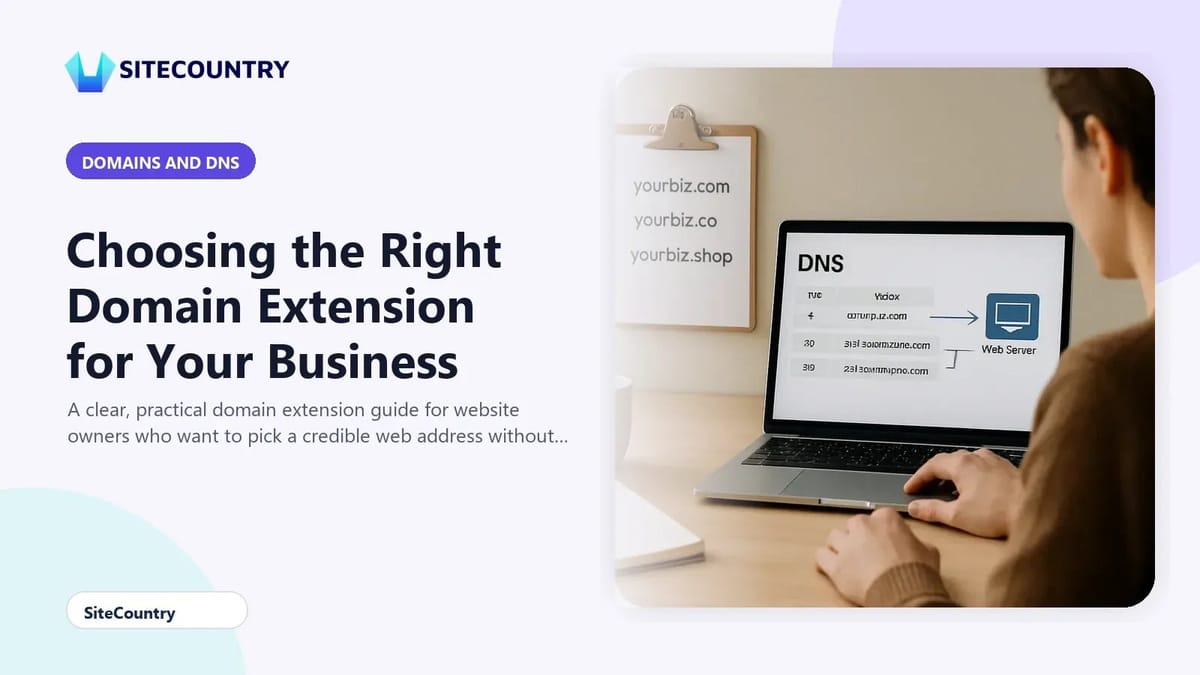
A domain extension is the part of a web address that sits after the final dot, the ".com" in yourbusiness.com or the ".shop" in yourstore.shop. It is officially called a top-level domain, or TLD, and it lives at the top of the Domain Name System hierarchy that makes the internet navigable. For anyone building a business site today, the TLD you choose shapes first impressions, customer trust, and even the price you pay at the registrar.
Finding a short, brandable .com is harder than it used to be. Most of the obvious ones were registered decades ago, and aftermarket prices can be punishing. The good news is that the right domain extension for your business does not have to be .com, as long as you pick something credible, relevant, and easy to remember. This guide walks through what TLDs are, why .com still leads, how newer options stack up, and how to make a confident choice.
Key Takeaways
- A domain extension is the top-level domain, or TLD, the letters after the final dot in a web address.
- .com remains the most recognized and trusted extension, but it is no longer the only credible option.
- ICANN organizes TLDs into four main types: generic, country-code, sponsored, and infrastructure.
- Search engines do not penalize newer extensions, so quality and relevance matter more than the suffix.
- Pick the TLD that fits your audience, budget, and brand, then focus energy on a clean, memorable name.
What Domain Extensions Actually Are
Every web address is split into three parts: a subdomain prefix such as "www," the registered name, and the extension. The extension is more than decoration. ICANN assigns the available TLDs, accredits the registries that operate them, and licenses the registrars that sell them to the public.
When the Domain Name System launched in the 1980s, only a handful of generic TLDs existed: .com, .net, .org, .edu, and .gov. Since then, the namespace has expanded dramatically.
The Four Official Types of TLDs
Even though there are now hundreds of usable suffixes, every TLD falls into one of four official categories. Understanding them helps you judge whether a particular extension fits your business.
| TLD type | What it covers | Examples |
|---|---|---|
| Generic TLD (gTLD) | Open or restricted extensions available to the public, including legacy and newer industry options. | .com, .net, .org, .shop, .blog, .law, .bank |
| Country-code TLD (ccTLD) | Two-letter extensions tied to a country or region; some require local presence, others are open. | .uk, .us, .de, .co, .ai |
| Sponsored TLD (sTLD) | Run by a sponsoring organization for a defined community, often with eligibility rules. | .gov, .edu, .mil |
| Infrastructure TLD | A single technical extension used behind the scenes by the internet itself. | .arpa |
Within the generic category, newer options such as .agency, .bio, .charity, and .shop are sometimes called new gTLDs, or nTLDs. They exist to give businesses more descriptive choices when a matching .com is unavailable or overpriced.
Why .com Still Feels Like the Default
The Domain Name Industry Brief reported roughly 166.6 million .com registrations as of June 30, 2026, making it by far the most populated extension on the internet. When someone hears a name spoken aloud, their first instinct is usually to type ".com" before anything else.
That habit has real business value. Customers are less likely to forget a .com address, less likely to mistype it, and more likely to trust it on a business card. If you can register a short, memorable .com that matches your brand, it is still the lowest-friction choice. Use the domain search tool to see whether your preferred name is actually available before you commit to an alternative.
When an Alternative Extension Makes Sense
There are plenty of situations where a non-.com extension is the smarter pick.
- Your exact-match .com is taken and the resale price is out of reach.
- Your business is tied to a country or city, and a ccTLD signals that clearly.
- Your industry has a descriptive TLD that reinforces what you do, such as .shop, .studio, or .law.
- You want a memorable, brandable name that is only available on a newer extension.
- You need a defensive registration on a less common TLD to protect your brand.
The key is credibility. Search engines have confirmed for years that they do not penalize newer TLDs; rankings depend on content quality, backlinks, and user experience, not the suffix.
How to Pick the Best Domain Extension for Your Business
Choosing a TLD is partly a marketing decision and partly a long-term cost decision. A short framework makes the tradeoffs easier to weigh.
- Start with .com. If a short, brandable .com is available at normal registration prices, take it.
- Define the audience. Local customers may respond better to a ccTLD or city extension; global customers usually prefer .com or a familiar generic option.
- Match the extension to the business. A bakery may benefit from .shop or .cafe; a consultancy might lean on .co, .agency, or .io.
- Watch the renewal price. Newer TLDs often carry higher first-year promos and steeper renewals, so check the long-term cost.
- Protect the brand. Once you choose a primary domain, consider registering common variations and typos on related TLDs to prevent competitor squatters.
- Plan for email and transfers. Make sure your registrar supports easy DNS changes, professional email addresses through professional business email, and smooth moves if you ever want to transfer your domain to another provider.
Common Pitfalls to Avoid
A few mistakes show up again and again when businesses pick extensions.
- Choosing a confusing TLD just to get a shorter name, then paying for it in mistyped traffic.
- Ignoring renewal pricing because the first year looked cheap.
- Forgetting that some restricted gTLDs, like .law and .bank, require verified credentials before registration.
- Letting the domain expire while focusing on hosting, which can hand the name to a third party.
- Picking a ccTLD with residency rules you cannot meet, then losing access at renewal time.
Action Checklist Before You Register
- Confirm the exact name you want is available on your preferred TLD.
- Compare first-year and renewal prices across at least two registrars.
- Decide whether a country-code or industry-specific extension better fits your audience.
- Register common variations to protect your brand.
- Point DNS to a reliable host and connect a professional email address before going live.
Frequently Asked Questions
Do search engines treat new domain extensions differently from .com?
No. Google and other major search engines have stated repeatedly that they evaluate content, backlinks, and user experience, not the TLD itself. A well-built site on .shop or .co can rank just as competitively as a .com, provided the brand and content are strong.
Is a country-code TLD a bad choice for an international business?
Not necessarily, but it sends a geographic signal. A .de address, for example, implies a German presence, while open ccTLDs like .co and .ai are widely used by global startups. If your customer base is truly international, a .com or a neutral generic extension usually travels better.
Why are some domain extensions so much more expensive?
Registry fees, demand, and renewal economics vary by TLD. Newer gTLDs often run aggressive first-year discounts to attract registrations, then renew at a higher price. Always check the renewal rate before you commit, because that is the real long-term cost of ownership.
Can I move my site to a different extension later?
Yes, but it is rarely free. Switching TLDs means updating links, redirecting the old address, and rebuilding any search rankings tied to the previous domain. The safest approach is to pick the extension you plan to keep for the next several years before you launch.
Should I register my domain on more than one extension?
For established brands, registering common variations on related TLDs is a reasonable defensive move. For early-stage businesses, it is usually smarter to invest in the primary domain, hosting, and content first, and revisit defensive registrations once revenue supports the extra cost.
Conclusion
The right domain extension for your business is the one that customers can type, remember, and trust. .com remains the safest default, but a credible alternative such as .co, .shop, or a relevant country-code TLD can work just as well when the .com you want is unavailable or unaffordable. Focus on a clean name, a credible extension, and a registrar that makes DNS, email, and transfers straightforward. With those pieces in place, your domain becomes a long-term asset rather than a recurring headache.